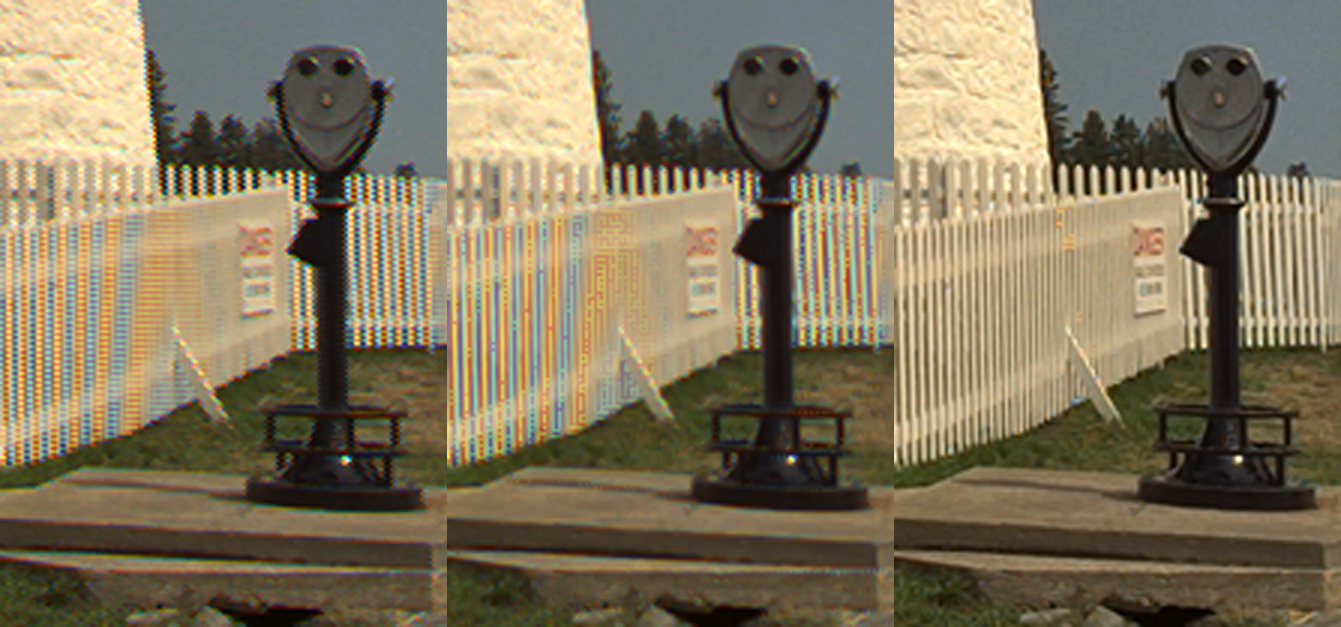
Digital cameras are important image input devices. Many digital color cameras use a single image sensor in order to lower cost. These cameras require the use of a CFA (color filter array) in front of the sensor pixels to be able to acquire color. Each pixel thus samples the intensity of just one color primary.
Here is an example of a typical Bayer Mosaic color arrangement, which puts red, green and blue filters in front of the sensor pixels.
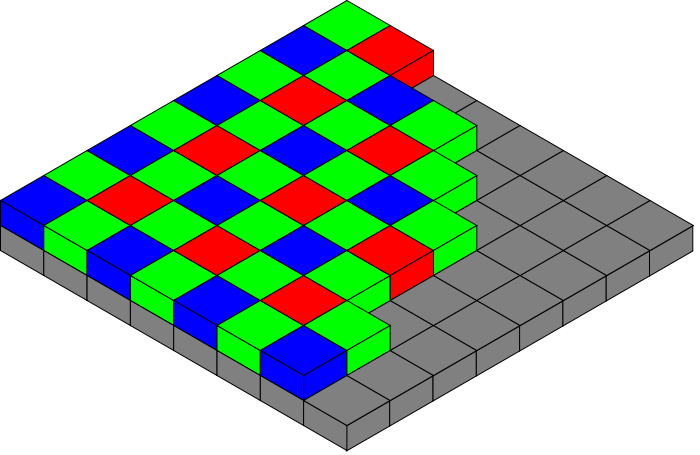
In order to recover full color images from such a CFA based detector, a method to calculate the missing colors at each pixel is needed, which is commonly called a color demosaicing algorithm. Due to the popularity of the Bayer pattern, the demosaicing functions currently work with the Bayer pattern exclusively. A variety of algorithms are known and implemented within NGI, but they all somehow have to make a trade-off between quality and speed. Depending on the needs of the quality-speed balance, the proper algorithm should be selected. Algorithms for demosaicing can be classified into non-adaptive and adaptive algorithms. Non-adaptive algorithms perform interpolation with a fixed pattern for each pixel, while adaptive algorithms may use different interpolation patterns depending on the image content. Thus, adaptive algorithms tend to be more complex in general.
Nearest neighbour demosaicing is the simplest of the demosaicing methods. Each interpolated value is taken from the nearest neighbour.
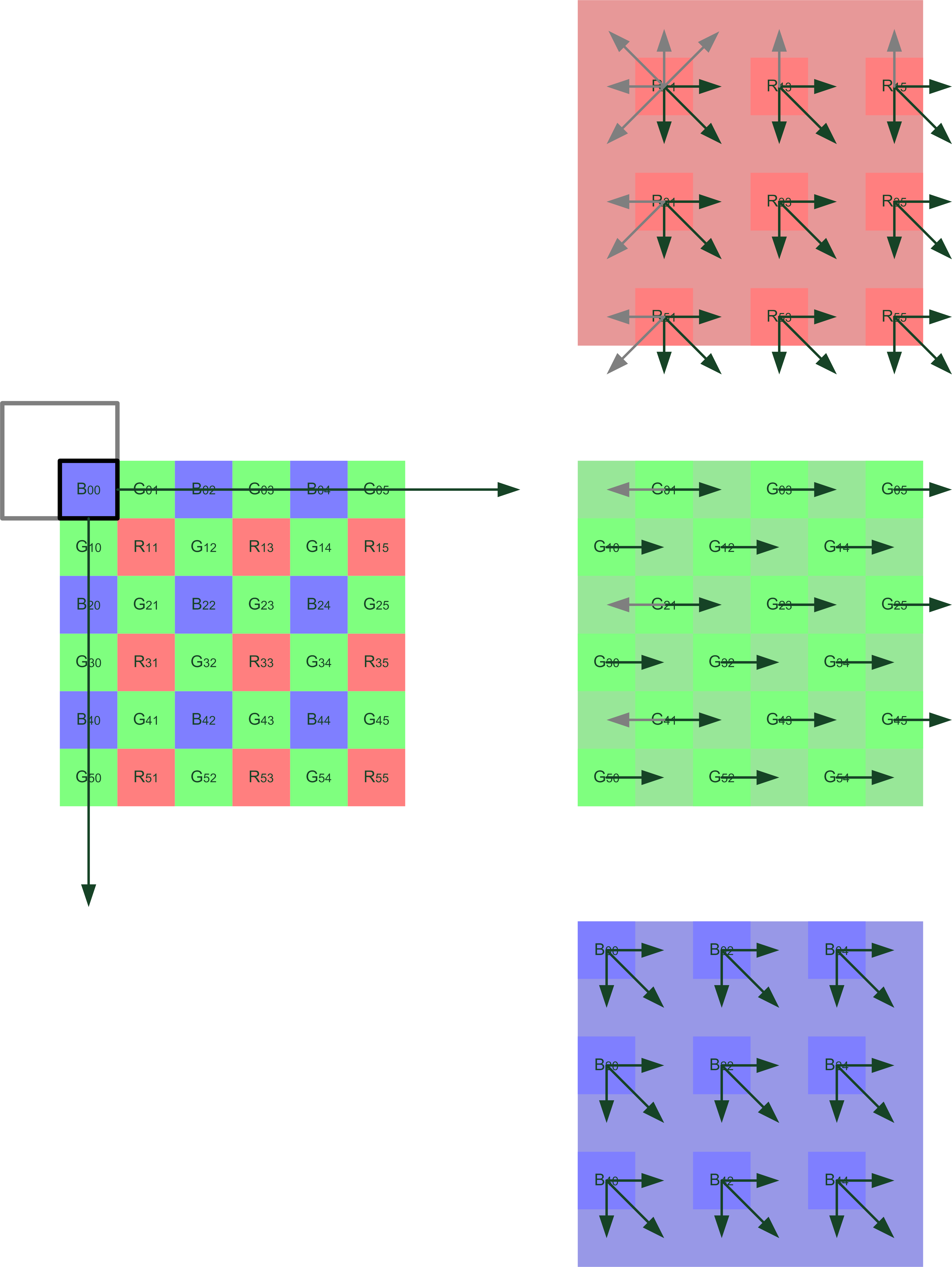
Bilinear demosaicing uses linear interpolation in two directions in order to achieve better image quality.
Bilinear demosaicing of the red value on a green pixel is done by averaging the horizontal neighbours: $R=\frac{R_1+R_2}{2}$.

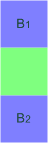
Bilinear demosaicing of the blue value on a green pixel is done by averaging the vertical neighbours: $B=\frac{B_1+B_2}{2}$.
Bilinear demosaicing of the red value on a blue pixel is done by averaging the diagonal neighbours: $R=\frac{R_1+R_2+R_3+R_4}{4}$.

Bilinear demosaicing of the blue value on a red pixel is done by averaging the diagonal neighbours: $B=\frac{B_1+B_2+B_3+B_4}{4}$.

Bilinear demosaicing of the green value on a red pixel is done by averaging the horizontal or vertical neighbours, taking the correlation in the red channel into account:
$$G=\left\{\begin{array}{cl} \frac{G_1+G_4}{2}, & \mbox{if }\vert R_1-R_4 \vert \< \vert R_2-R_3 \vert \\ \frac{G_2+G_3}{2}, & \mbox{if }\vert R_1-R_4 \vert > \vert R_2-R_3 \vert \\ \frac{G_1+G_2+G_3+G_4}{4}, & \mbox{if } \vert R_1-R_4 \vert = \vert R_2-R_3 \vert \end{array}\right.$$

Bilinear demosaicing of the green value on a blue pixel is done by averaging the horizontal or vertical neighbours, taking the correlation in the blue channel into account:
$$G=\left\{\begin{array}{cl} \frac{G_1+G_4}{2}, & \mbox{if }\vert B_1-B_4 \vert \< \vert B_2-B_3 \vert \\ \frac{G_2+G_3}{2}, & \mbox{if }\vert B_1-B_4 \vert > \vert B_2-B_3 \vert \\ \frac{G_1+G_2+G_3+G_4}{4}, & \mbox{if } \vert B_1-B_4 \vert = \vert B_2-B_3 \vert \end{array}\right.$$

Adaptive homogeneity demosaicing uses a sophisticated and recent algorithm to reduce interpolation artefacts.
The various demosaicing methods implemented in nGI exhibit different characteristics. Nearest neighbour demosaicing is the simplest algorithm but it shows serious zippering and other artefacts. Bilinear interpolation is better and reduces zippering considerably. The best algorithm is adaptive homogeneity-directed demosaicing, but this is also the slowest variant.